
Aerospace
SUPERIOR PRECISION FOR EXTREME DEMANDS.
Aerospace components combine the highest standards of precision, safety, and durability with sophisticated materials and complex geometries. Titanium and nickel-based alloys, delicate structures, and hard-to-reach functional surfaces place special demands on machining and workpiece clamping. Whether it’s kerosene injection nozzles with heat shields for aircraft engines, turbine blades, or tensile test specimens: what matters most is a clamping technology that can reproducibly position even complex and delicate components, clamp them securely, and keep them optimally accessible for machining.
STERMAN consistently develops customized clamping systems and production technology based on workpiece geometry and the manufacturing process. Depending on the application, the focus is on positioning with micrometer precision, low-deformation clamping that protects the workpiece, reproducible reference positions, or maximum accessibility to complex contours. A specialized solution for challenging workpiece geometries is the STERMAN clamp clamping system, in which the workpiece is held precisely within defined clamping zones, thereby leaving large areas freely accessible for machining. Custom precision clamping systems, spindle assemblies, and fixtures—right through to automated special-purpose machines—thus enable the reliable machining of high-quality aerospace components. For applications with particularly high requirements for workpiece positioning and repeatability, PICEA can additionally detect the workpiece position and actively correct it with a control resolution of up to 0.5 μm.
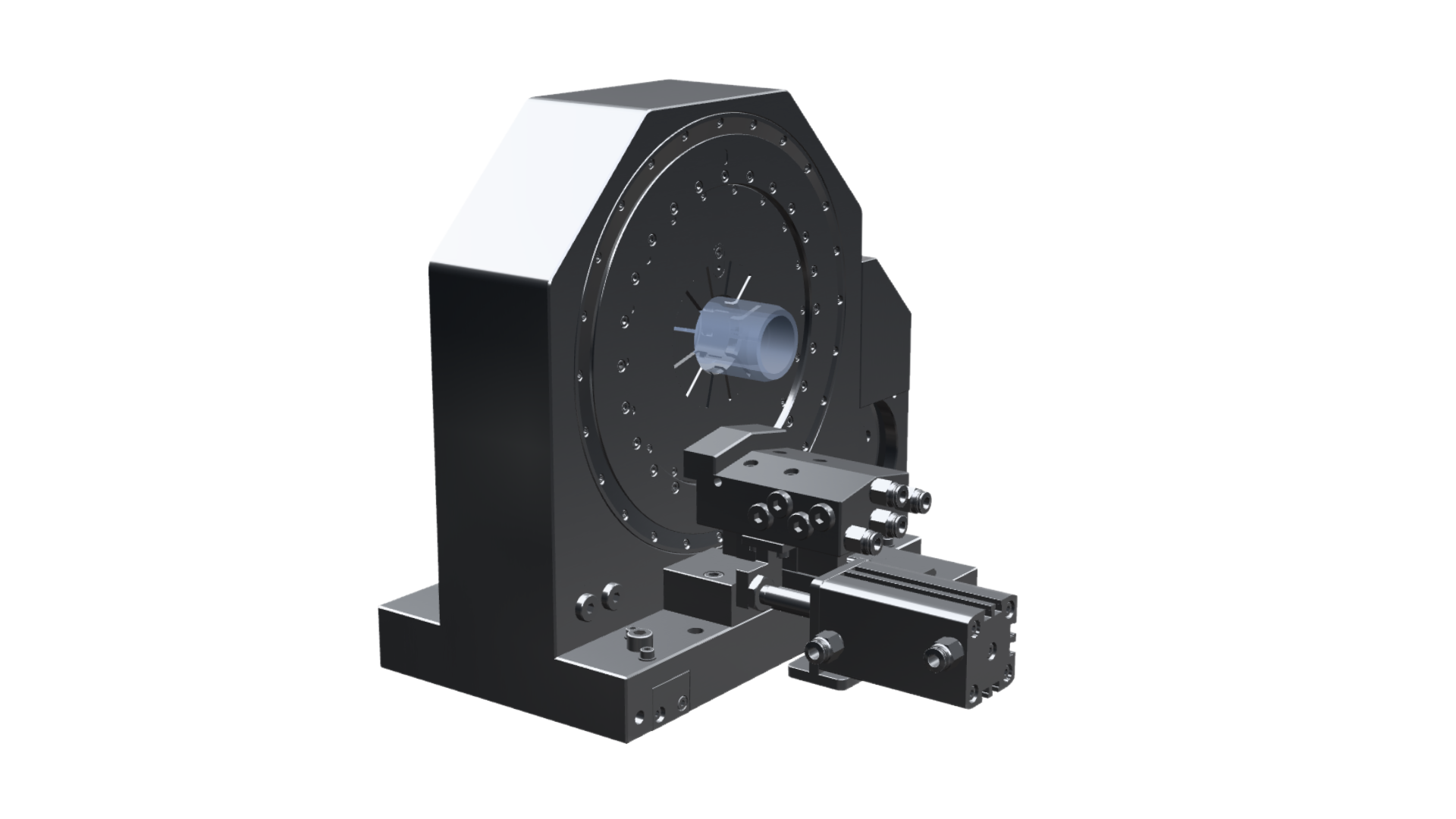


CUSTOMIZED: LIKE THE WORKPIECE ITSELF.
We develop and manufacture our clamping and machining solutions in the same way that high-precision individual parts meet the highest demands in innovative applications: with micrometer precision, smart and precisely tailored to your needs.
Development partner from concept to commissioning.
Whether it’s a new machine, a retrofit, or the modification of existing machine tools, STERMAN supports projects from the initial idea and design through engineering, manufacturing, and assembly to commissioning—and, upon request, well beyond that. With a vertical integration rate of over 85 percent, our solutions are primarily manufactured at our facility in St. Georgen in the Black Forest. For an initial clamping concept, a workpiece drawing and the essential information about the machining process are usually sufficient.


MADE IN THE BLACK FOREST. STERMAN ENGINEERING FOR AEROSPACE.
Custom clamping systems, fixtures, and machines for demanding applications in the aerospace industry around the world.
Specific applications demonstrate the exceptional breadth of this expertise: STERMAN develops high-precision clamping solutions for the machining of complex kerosene injectors with heat shields for aircraft engines, as well as for sophisticated turbine blades. Solutions tailored individually to the workpiece and process are also used in the precise manufacture and machining of tensile test specimens for testing high-strength materials. The focus here is on reproducible positioning, workpiece-friendly clamping, and optimal accessibility for demanding machining processes.



STERMAN Expertise:
FAQ – Aerospace
Why do aerospace components often require custom clamping solutions?
Complex geometries, delicate structures, challenging materials, and tight dimensional and positional tolerances quickly push standard clamping devices to their limits. At the same time, many functional surfaces must remain freely accessible for machining. STERMAN therefore develops clamping solutions based on the part geometry, machining process, and required accuracy. Particularly for high-quality aerospace components with correspondingly high part costs, a custom-designed clamping solution can also be a decisive economic factor: process reliability, reproducible machining, and the prevention of stress-induced part defects all help to reduce scrap and ongoing manufacturing costs.
Which clamping technology is suitable for complex aerospace geometries?
The right clamping principle depends heavily on the part. In addition to conventional precision workholding systems, STERMAN clamp workholding can offer particular advantages for complex geometries: the workpiece is held selectively at defined clamping zones, leaving large areas freely accessible for machining. Different clamping principles can also be combined and tailored to the specific manufacturing task.
What requirements must clamping systems for the aerospace industry meet?
The focus is on high accuracy and repeatability, process reliability, and workpiece clamping with minimal deformation. Complex components made of high-strength steels, titanium, or nickel-based alloys must remain reliably positioned and clamped even under high machining forces. Depending on the process, additional requirements for documentation and traceability may also apply.
What components does STERMAN machine for aerospace applications?
Applications that have been successfully implemented include, among others, complex kerosene injection nozzles with heat shields for aircraft engines, turbine blades, and tensile test specimens. The clamping solution is individually tailored to the component’s geometry, material, and machining process. For these applications, the focus is particularly on reproducible positioning, workpiece-friendly clamping, and high machining freedom.
Why do titanium and nickel-based alloys pose special challenges for clamping technology?
These materials are used for components subjected to high stresses due to their mechanical and thermal properties, but at the same time they pose significant challenges for machining. The clamping system must reliably absorb the machining forces that arise while simultaneously ensuring compliance with the required dimensional and positional tolerances. For this reason, clamping force, clamping ranges, and workpiece support are specifically tailored to the material, geometry, and machining strategy.