
PICEA piezo-intelligent clamping system
Piezo Intelligent Clamping Systemfor Industrial Applications
Precision-ControlledActuators
IntelligentSystem Integration
Cyber-physicalinteraction
Energy-AdaptiveDynamics
Application-SpecificScalability
STERMAN PICEA transforms conventional workpiece clamping into an intelligent, actively controlled precision system. The combination of piezoelectric sensors and actuators, high-precision clamping mechanisms, and real-time control makes it possible not only to securely hold workpieces in place, but also to continuously detect positional deviations and precisely compensate for them through adjustments in the nanometer range.
With a control accuracy of up to 0.0005 mm, PICEA opens up new possibilities for machining delicate, thin-walled, and geometrically complex components. Bidirectional real-time communication with the machine control system also enables continuous monitoring of relevant clamping and process parameters, as well as their workpiece-specific traceability.
In this way, clamping technology becomes an active component of digitally networked manufacturing—ensuring the highest precision, reproducible machining quality, and stable, adaptive manufacturing processes.
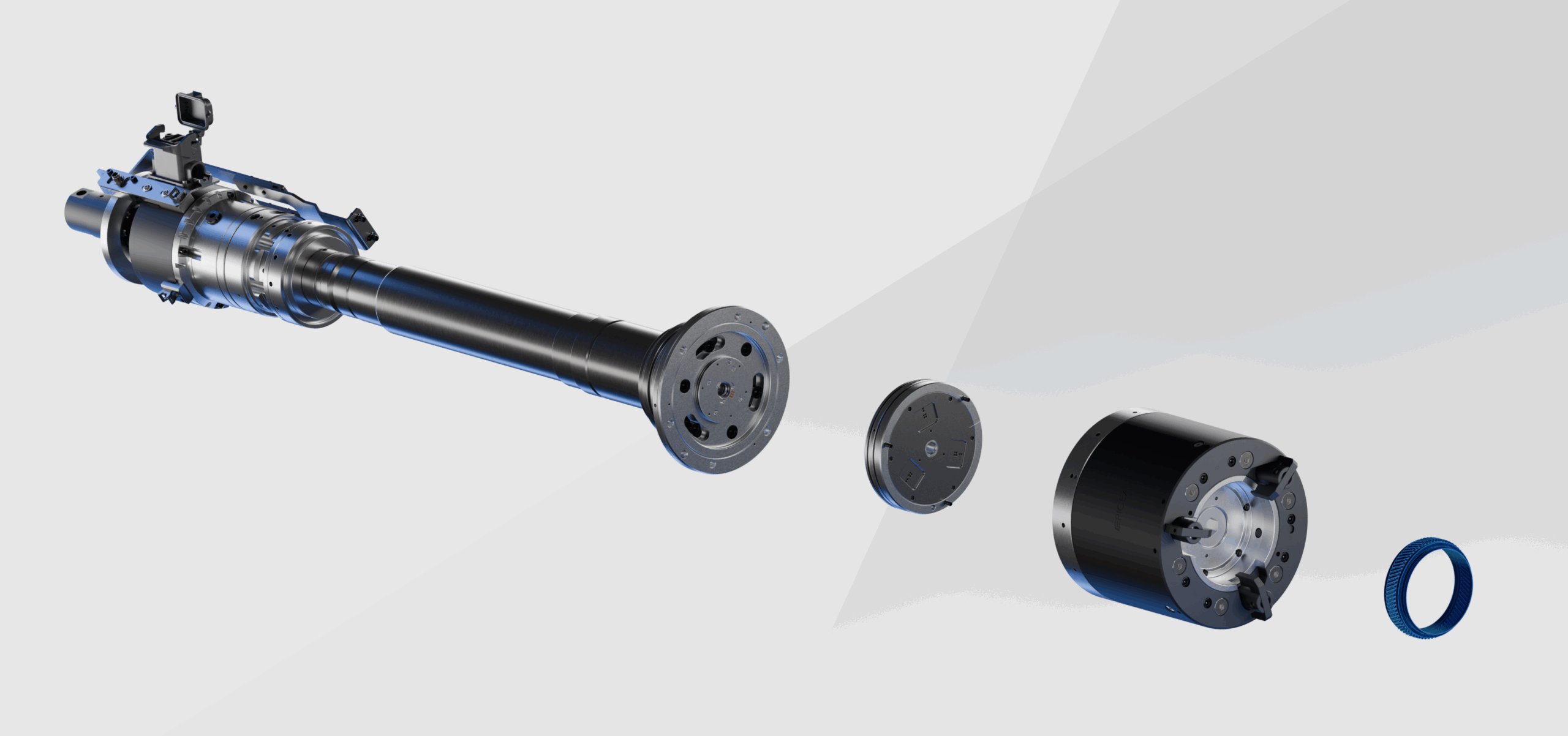
Digital clamping system, power electronics and power and data transmission
The STERMAN PICEA Mechatronic Clamping Cylinder is an intelligent spindle assembly designed for precise force clamping and digital monitoring of modern clamping systems. Its integrated digital rotary transmitter enables contactless power transmission as well as bidirectional data transfer in real time. This allows electrical, piezo-based, and mechatronic clamping systems to be controlled and regulated directly via the machine control system. The integrated sensor system continuously monitors clamping force, position, temperature, and other operational parameters. In this way, PICEA combines reliable force-based clamping and power supply with intelligent process monitoring—serving as the foundation for adaptive clamping strategies and fully networked manufacturing processes.
The STERMAN PICEA electronic module is an integrated control and communication unit for intelligent mechatronic clamping systems. Its real-time control capability enables the precise processing of control and process signals, as well as the targeted activation of electrical and piezo-based clamping functions. Robust electrical connections ensure reliable power and signal transmission even under demanding industrial operating conditions. The module thus combines fast response times with stable control loops and reproducible clamping operations—serving as the electronic foundation for adaptive clamping strategies and fully automated manufacturing processes.
The STERMAN PICEA piezoelectric centering and face-clamping chuck is an intelligent, mechatronic clamping system designed for the high-precision machining of thin-walled housings, precision rings, and complex drive components. Its piezoelectric sensors and actuators enable active workpiece centering with a control accuracy of up to 0.0005 mm. The integrated real-time control continuously corrects positional deviations, while the hydraulic face clamping secures the workpiece axially. In this way, PICEA combines adaptive precision clamping with digital process monitoring and full traceability—ensuring the highest machining accuracy and reproducible manufacturing quality.
Features
- Integrated measurement prior to workpiece clamping or machining, performed directly by the clamping system—for example, at the machine tool’s pick-up station
- µ-precise electrically controllable and deformation-free electrical centering through to the deliberate µ-precise deformation of workpieces
- Can be combined with conventional pneumatic or hydraulic clamping systems, such as an additional swiveling face clamp
- Deformation-free active or pulsating damping of machining forces and vibrations during machining
- Real-time monitoring of all process parameters during machining using smart big data and AI capabilities (all clamping and process parameters can be saved and retrieved on a per-part basis)
- Real-time calculation of actual machining parameters and proactive correction directly within the process
- Integrated STERMAN PICEA Intelligence control unit as a communication interface to the conventional machine control system
- Bidirectional real-time transmission of power and data at 3,000 1/min between the clamping system and the PICEA Intelligence control unit
- Can be easily integrated into existing machines via a retrofit, with simple connection to the machine control system via ProfiNET and ProfiBUS
Development partner from concept to commissioning.
Whether it’s a new machine, a retrofit, or the modification of existing machine tools, STERMAN supports projects from the initial idea and design through engineering, manufacturing, and assembly to commissioning—and, upon request, well beyond that. With a vertical integration rate of over 85 percent, our solutions are primarily manufactured at our facility in St. Georgen in the Black Forest. For an initial clamping concept, a workpiece drawing and the essential information about the machining process are usually sufficient.


Turnkey for new machines or retrofit for the conversion of existing systems
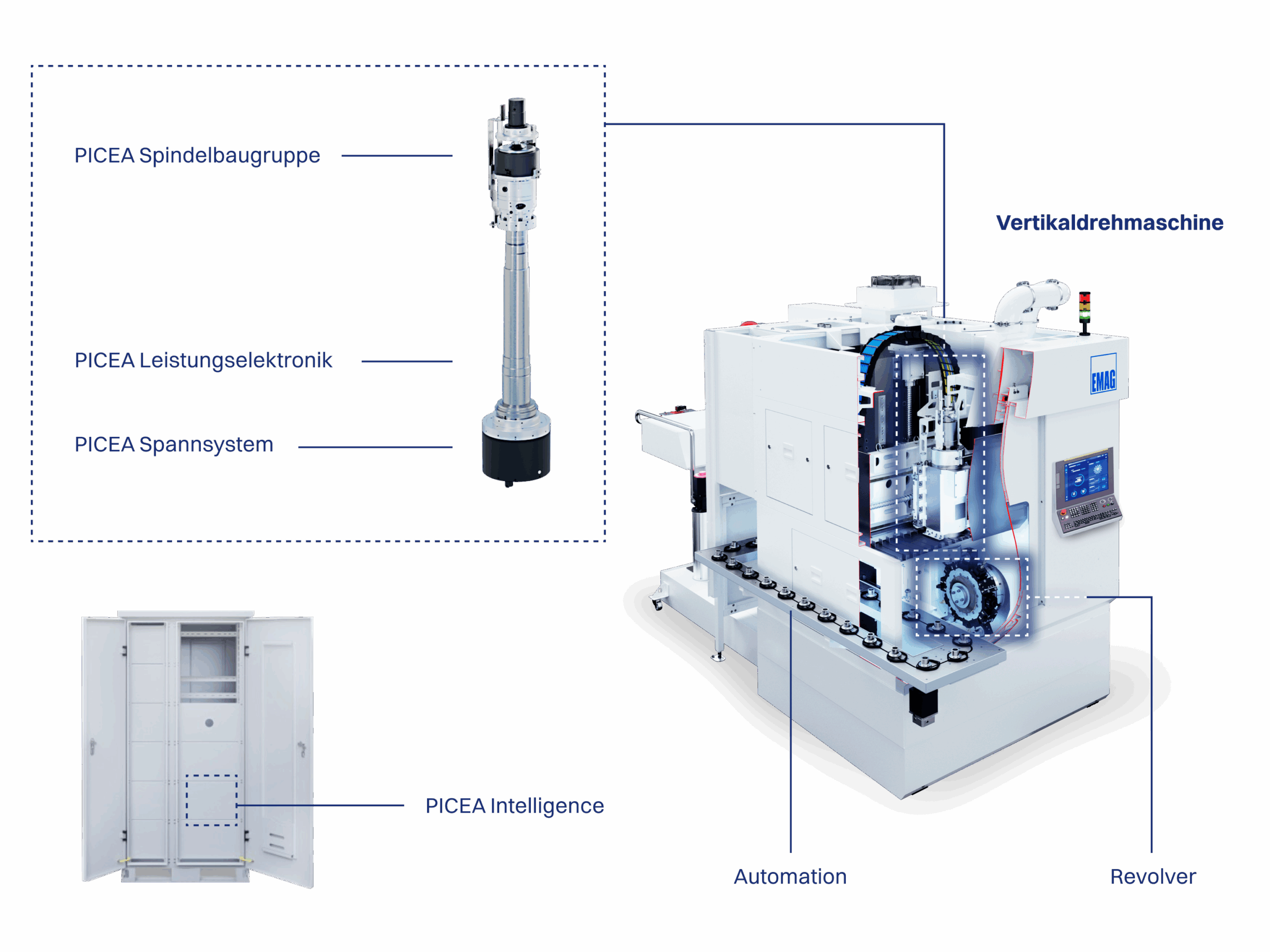
APPLICATION EXAMPLE: EMAG VL 4 WITH PICEA
The EMAG VL 4 modular vertical lathe shows STERMAN’s PICEA in industrial use. The adaptive clamping system enables precise, low-distortion clamping of thin-walled gear components, thereby laying the foundation for reliable hard turning operations.
PICEA can be implemented as original equipment on a new machine or adapted to an existing machine as part of a retrofit project. PICEA clamping technology, power electronics and spindle assembly are designed so that the technology can be easily integrated into a standard A6 DIN55026 / DIN55028 machine spindle.
The PICEA Intelligence control unit is added to the machine’s control cabinet. Communication between the machine controller and PICEA Intelligence is based on either PROFIBUS (Process Field Bus) or PROFINET (Process Field Network).
Upon request, PICEA Intelligence can transfer workpiece-specific data on measurements, clamping, and processes bidirectionally and in real time to higher-level control computers and, for example, actively intervene in machining strategies using AI or other calculation algorithms.
STERMAN Expertise:
FAQ – PICEA Piezo-Intelligent Clamping System
What is PICEA, and how does this system differ from conventional clamping technology?
PICEA (PIEZO INTELLIGENT CLAMPING ENTITY FOR INDUSTRIAL APPLICATIONS) is STERMAN’s intelligent, mechatronic product family for high-precision and digitally networked clamping processes. It combines piezoelectric sensors and actuators, integrated real-time control, and contactless power and data transmission into a smart clamping system.
The key difference from conventional clamping technology lies in the active control of the workpiece’s position. While traditional clamping systems secure a workpiece in a defined position, PICEA can measure its position, detect deviations, and correct them through targeted adjustments. Workpiece centering thus becomes a controllable process that can be monitored and adjusted even during machining.
At the same time, bidirectional communication enables the exchange of relevant control and process data between the clamping system and the machine control system. This transforms a mechanical clamping function into an intelligent process component that combines precision clamping, active control, and digital process monitoring.
How does a piezo-intelligent clamping system work, and how are workpiece deviations actively corrected?
A piezo-intelligent clamping system uses piezoelectric actuators and high-resolution sensors to precisely detect the position of a workpiece and adjust it as needed. This is based on the piezoelectric effect: When an electrical voltage is applied, certain materials change their dimensions, thereby enabling extremely small, controllable movements.
In PICEA, the captured position and status information is processed by an integrated real-time control system. If the system detects a deviation from the specified workpiece position, the piezoelectric actuators can perform the appropriate corrective movements. The sensors then detect the resulting state and feed it back into the control system.
This closed-loop control system enables active workpiece centering and the targeted compensation of positional deviations. In combination with the mechanical clamping function, this creates an adaptive clamping system that does not rely solely on a workpiece position set once and for all.
This operating principle is particularly interesting for thin-walled, delicate, and geometrically complex precision components, where even the slightest positional deviations can affect the subsequent machining quality.
What advantages does PICEA offer in terms of precision, process reliability, and automated manufacturing?
PICEA expands upon traditional workpiece clamping by incorporating active measurement, control, and communication functions. This not only allows workpiece deviations to be detected but also enables them to be specifically corrected using the available adjustment and control options. This opens up new possibilities for improving concentricity, coaxiality, and reproducible workpiece positioning.
A key advantage lies in continuous process monitoring. While conventional clamping systems often only provide the preset clamping condition, PICEA can continuously capture relevant position, clamping, and status information and make it available for control and machine operation. This makes changes in the clamping process more transparent and allows them to be addressed at an early stage.
Digital data collection also supports workpiece-specific documentation, traceability, and analysis of manufacturing processes. The information obtained can also serve as the basis for condition-based maintenance and data-driven process optimization.
Thanks to the modular integration of mechatronic clamping technology, electronics, and digital power and data transmission, PICEA is suitable for both newly designed machines and technically compatible retrofit applications. The system thus combines high-precision clamping technology with the requirements of an increasingly automated and networked manufacturing environment.
What level of accuracy does PICEA achieve, and how significant are adjustments in the nanometer range?
PICEA’s piezoelectric control system enables a control accuracy of up to 0.0005 mm, or 0.5 micrometers. The integrated piezoelectric actuators can perform extremely fine adjustments in the nanometer range, thereby precisely correcting very small positional deviations.
It is important to distinguish between actuator movement, control accuracy, and actual workpiece accuracy. While the actuators enable minute movements, control accuracy describes the precision of the controlled positioning. The ultimate machining quality achievable also depends on workpiece geometry, clamping conditions, machine rigidity, and the effects of the machining process.
Active control makes it possible, in particular, to specifically compensate for positional deviations and create the conditions for improved concentricity and coaxiality. For sensitive or thin-walled components, this can make a decisive contribution to reproducible clamping conditions and higher manufacturing quality.
PICEA thus not only enables highly precise positioning, but above all the ability to actively influence the workpiece’s position within the specified technical limits.
What sensors are integrated into PICEA, and how do they work with the real-time control system?
PICEA combines high-resolution piezoelectric sensors with integrated actuators and real-time control electronics. Depending on the system configuration, relevant state variables such as workpiece position, clamping force, temperature, and other application-specific parameters can be measured.
The sensor system forms the metrological basis of the intelligent clamping process. Its signals are processed by the control electronics and compared with the specified setpoints or control conditions. If relevant deviations are detected, corresponding control commands can be sent to the piezoelectric actuators.
This creates a closed-loop control system consisting of measurement, data processing, and targeted corrective movements. As a result, the workpiece clamping system is not only activated but also continuously monitored for relevant status variables.
The collected information can also be transmitted to the machine control system via the digital communication interface. In this way, the integrated sensor technology lays the foundation for adaptive clamping strategies, reproducible control sequences, and data-driven monitoring of complex manufacturing processes.
What process data does PICEA collect, and how can it be used for traceability and process optimization?
PICEA enables the continuous acquisition and processing of relevant clamping and process data. Depending on the specific system configuration, this may include workpiece position, clamping force, positioning and control movements, temperature, sensor readings, and other application-specific status parameters.
The integrated real-time communication enables the bidirectional exchange of this information between the intelligent clamping system and the machine control system. As a result, measured values can not only be used for immediate control but also made available for higher-level monitoring and documentation functions.
The workpiece-specific assignment of the recorded process information is particularly valuable. It makes it possible to document the clamping and control conditions of individual machining operations in a traceable manner and to evaluate them specifically in the event of quality deviations.
In addition, the data collected provides the basis for analyzing recurring process deviations, optimizing clamping strategies, and, in the future, for condition-based maintenance or data-driven predictive models.
In this way, PICEA combines physical workpiece clamping with a digital information base, making manufacturing processes more transparent, easier to track, and capable of targeted optimization.