
Automotive & Automobile
PRECISION FOR THE POWERTRains OF THE FUTURE.
The automotive industry places the highest demands on precision, productivity, and process reliability. Whether it’s an efficient internal combustion engine, a hybrid powertrain, or electric mobility: lighter components, higher torques, new materials, and complex, increasingly thin-walled geometries make precision machining more challenging. Particularly for components such as thin-walled gear wheels, differential housings, drive shafts, or aluminum housings for electric motors, clamping technology plays a decisive role in ensuring dimensional accuracy, concentricity, deformation, and the quality of the machining result.
STERMAN consistently develops customized clamping systems and production technology based on workpiece geometry and the machining process. Low-deformation clamping, reproducible centering, high torque transmission, and optimal workpiece accessibility enable high-precision machining of complex automotive components—even in automated manufacturing processes and for high-volume production. From precision mechanical clamping systems to spindle assemblies and fixtures, all the way to special-purpose machines and the intelligent PICEA clamping technology, we create solutions for efficient, flexible, and future-proof automotive production.
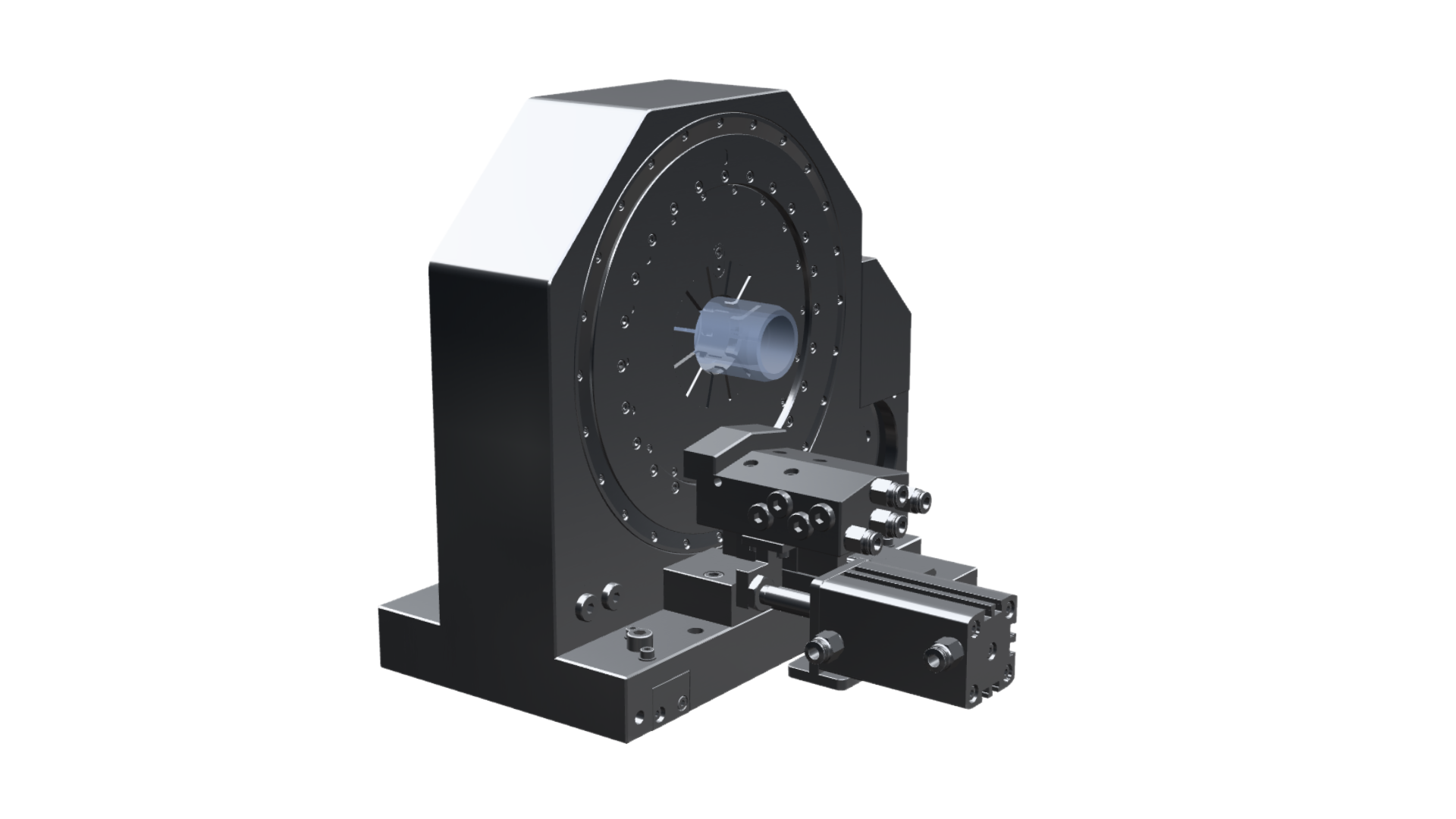


Tailor-made: like the workpiece itself.
We develop and manufacture our clamping and machining solutions in the same way that high-precision individual parts meet the highest demands in innovative applications: with micrometer precision, smart and precisely tailored to your needs.
Development partner from concept to commissioning.
Whether it’s a new machine, a retrofit, or the modification of existing machine tools, STERMAN supports projects from the initial idea and design through engineering, manufacturing, and assembly to commissioning—and, upon request, well beyond that. With a vertical integration rate of over 85 percent, our solutions are primarily manufactured at our facility in St. Georgen in the Black Forest. For an initial clamping concept, a workpiece drawing and the essential information about the machining process are usually sufficient.


MADE IN THE BLACK FOREST. STERMAN ENGINEERING FOR THE AUTOMOTIVE INDUSTRY.
Custom clamping systems, fixtures, and machines for demanding automotive applications around the world.
Specific applications demonstrate the breadth of our automotive expertise—from traditional powertrains to electric mobility. These include the complete machining of piston tops and bottoms on sliding-jaw mandrels for MAHLE and Kolbenschmidt, the complete machining of tripods for the powertrains of modern vehicles for Volkswagen, as well as the drilling and turning of electric drive shafts in a single setup using a STERMAN center drive for BMW. STERMAN technology is also used in the manufacture of electric drives, for example, in the machining and joining of laminated stacks for Bosch, as well as in the turning and joining of rotors for axial-flow electric motors for Mercedes-Benz.




















STERMAN Expertise:
FAQ – Automotive & Cars
When is a custom clamping solution appropriate in automotive manufacturing?
A custom clamping solution is particularly useful when standard clamping devices reach their limits in terms of workpiece geometry, precision, cycle time, or automation. This applies, for example, to thin-walled gear wheels, differential housings, drive shafts, or components of electric drives. STERMAN views the workpiece, machine, and machining process as a single integrated system and develops clamping solutions specifically tailored to the respective manufacturing task. Early involvement in the project planning phase offers additional advantages: experience from comparable applications and lessons learned can be incorporated into the machine design and process layout from the outset.
Which clamping systems are suitable for automotive applications?
The appropriate clamping method depends not only on the industry, but also on the workpiece geometry, machining process, material, and required accuracy. For example, sleeve mandrels, collet chucks, sliding-jaw and diaphragm clamping systems, as well as centering, face, and pull-down clamping systems are used. For complex tasks, STERMAN combines different clamping principles or develops customized solutions. What matters is not the clamping device from the catalog, but the technically optimal solution for the workpiece and its geometry.
What must clamping technology be capable of for automotive mass production?
Automotive clamping technology must combine high precision and process reliability with short cycle times and cost-effective mass production. It must provide reproducible centering, defined clamping forces, high repeatability, and reliable performance across large production runs. At the same time, the clamping system must integrate securely into automated manufacturing processes and ensure consistent clamping conditions throughout the entire production run. Ease of maintenance also plays a particularly important role over the entire life cycle, especially for high-volume production. Viewed over the entire life cycle, a custom-designed clamping solution can be more cost-effective than a standard solution despite a higher initial investment: low scrap rates, optimized cycle times, high process stability, ease of maintenance, and a wear-optimized design reduce the ongoing costs of series production.
How can short cycle times and high process reliability be combined?
The key lies in a clamping concept that is tailored from the outset to the workpiece, the machining process, and automation. Short clamping and changeover times must not come at the expense of centering, clamping force, or repeatability. Defined clamping sequences, robust mechanics, process monitoring, and automation-compatible interfaces create the conditions for fast yet stable production runs.
How can different component variants be manufactured using a single clamping system?
To achieve this, modular base clamping systems can be combined with workpiece-specific components. Clamping contours, fixtures, or centering elements are adapted to the respective component variant, while the basic system’s key functions and interfaces remain unchanged. This allows for reduced changeover times and setup times without compromising accuracy or process reliability.
Which clamping technology is suitable for electric mobility?
Electric drive components often place special demands on clamping technology: thin-walled aluminum housings, rotor and stator components, electric drive shafts, and components of axial-flow motors must be machined with high precision and minimal deformation. Depending on the application, systems such as centering and face clamping systems, diaphragm chucks, hydraulic expansion clamping systems, or intelligent mechatronic clamping technology are used. STERMAN consistently develops clamping solutions based on component geometry, the machining process, and the required accuracy.